

Your funnel might have all the right pieces in place. But is it giving people enough reason to trust you?
Let’s look at where trust can break down in your wellness marketing funnel, and how the S5 Trust Method™ helps determine whether your messaging builds confidence that moves buyers closer to a sale, or creates doubt that sends them back to the scroll.
First, a story…
I wanted to believe those five-star reviews.
All 40+ of them.
I’d been conducting research for a project. A natural supplement for menopausal symptoms. And less than a month ago on this particular retail site, the product had no reviews. Zero.
Now it had dozens. Glowing ones, too.

That should have created more confidence for the buyer, right?
Instead, I got suspicious as hell. So I kept reading.
And the more I read through them, the less I trusted what I was seeing.
Several reviews mentioned how easy the supplement was to add to their daily routine (ok, but the simplicity of swallowing a pill and calling it a ‘daily routine’ isn’t something that would come to mind if I was writing a review).
Many others said they’d bought it for their mother (really??).
The language across dozens of reviews was too similar, right down to the vague descriptions of the product’s benefits.
What was suspiciously absent from personal reviews was that no specific menopausal symptoms were addressed. In my experience, when a woman has unbearable hot flashes or meno-rage she’s talking about it (and posting about it on Instagram).
Now, the optimist in me hopes every review was genuine. But it not only made me question the product, I questioned if the business itself was behind this online love-bombing.
Incentivized reviews are an established marketing practice that can have their place in a funnel. However, the FTC has rules on this and this instance felt sketchy.
And that’s a problem worth noting if you sell health & wellness products. Because having the right marketing assets in place doesn’t guarantee they’re doing the job you think they are.
Why trust deserves more attention in 2026 and beyond
According to Edelman’s 2026 Trust Barometer, 88% of surveyed consumers consider trusting a brand an important or critical factor when deciding what to buy.
Product quality came in at 89%. Product value came in closely at 88%.
In other words, trust belongs in the same conversation as product quality and value when we’re talking about purchasing decisions.
And for wellness brands, there’s another layer.
Edelman’s 2026 Special Report on Trust and Health found that global confidence in people’s ability to find answers to health questions and make informed decisions fell 10 percentage points from 2025 to 2026.
That’s a substantial drop when people have access to enormous amounts of health information, yet feel less confident about what to believe.
So when someone considers buying a supplement, wellness device, or nutritional oils, that purchase needs to earn its place among other financial priorities like the steady increase in groceries and gas.
They may be asking themselves:
Is this product worth the money?
Can I believe what this company is telling me?
What if it doesn’t live up to my expectations?
This is why I believe we’re operating in a trust economy.
Trust isn’t new. But with more information to sort through, more claims to evaluate, and more competition for people’s money, brands that deliberately earn audience trust and confidence have a clear opportunity to stand apart.
Which brings me to the marketing funnel.
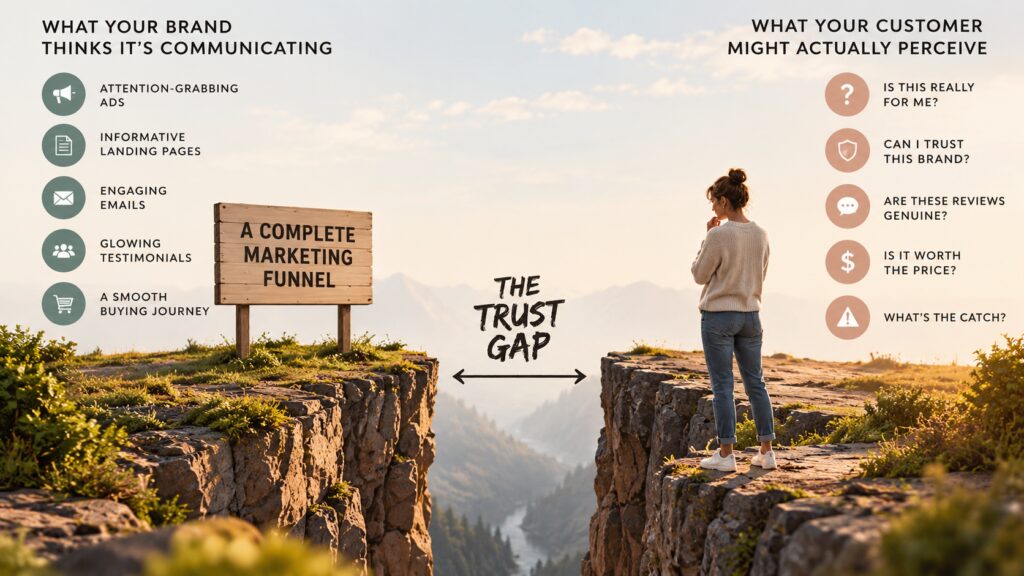
Your funnel can be complete and still have a trust problem
A typical wellness marketing funnel might include organic content, Meta ads, landing pages, product information pages, emails, checkout, and post-purchase follow-up.
A more developed marketing funnel might incorporate customer reviews, user-generated content (UGC), and influencer partnerships, giving potential buyers additional opportunities to learn about a product and evaluate its credibility.
But adding more voices to your marketing doesn’t automatically make those voices more believable.
More things to consider…
Consider a supplement brand running an ad about a particular ingredient.
Someone clicks because they want to know more.
But the landing page doesn’t mention the ingredient at all. It’s full of beautifully packaged promises about feeling your best, with little explanation of the mechanism, its quantity, or the evidence supporting the advertised benefit.
The person leaves.
Was the ad ineffective? Was the page too long? Was the price too high?
Maybe.
Or maybe the brand promised useful information and didn’t deliver it.
Or maybe you didn’t meet their stage of awareness.
Analytics can show you that someone clicked and left. They can’t tell you exactly what disappointed that person.
Yet brands often respond by rewriting headlines, changing buttons, or producing another batch of ads without investigating why the customer hesitated.
A technically complete funnel isn’t necessarily a trustworthy one.
Which raises a question I think more wellness brands should be asking:
How do we know whether our marketing is actually building trust?
How to examine trust using
the S5 Trust Method
Trust is a difficult measure to pin down.
It’s not a straightforward metric like a checkout conversion or an email open rate. And a click can indicate curiosity but doesn’t tell you whether someone believes what they’ve just read.
However, difficult to measure doesn’t mean impossible to investigate and shore up.
I developed the S5 Trust Method™ to provide a consistent framework for examining how messaging affects the customer experience.
Its five elements are Signal, Strategy, Sequence, Story, and Safety.
Each offers a different place to look when you’re trying to understand why people might hesitate.
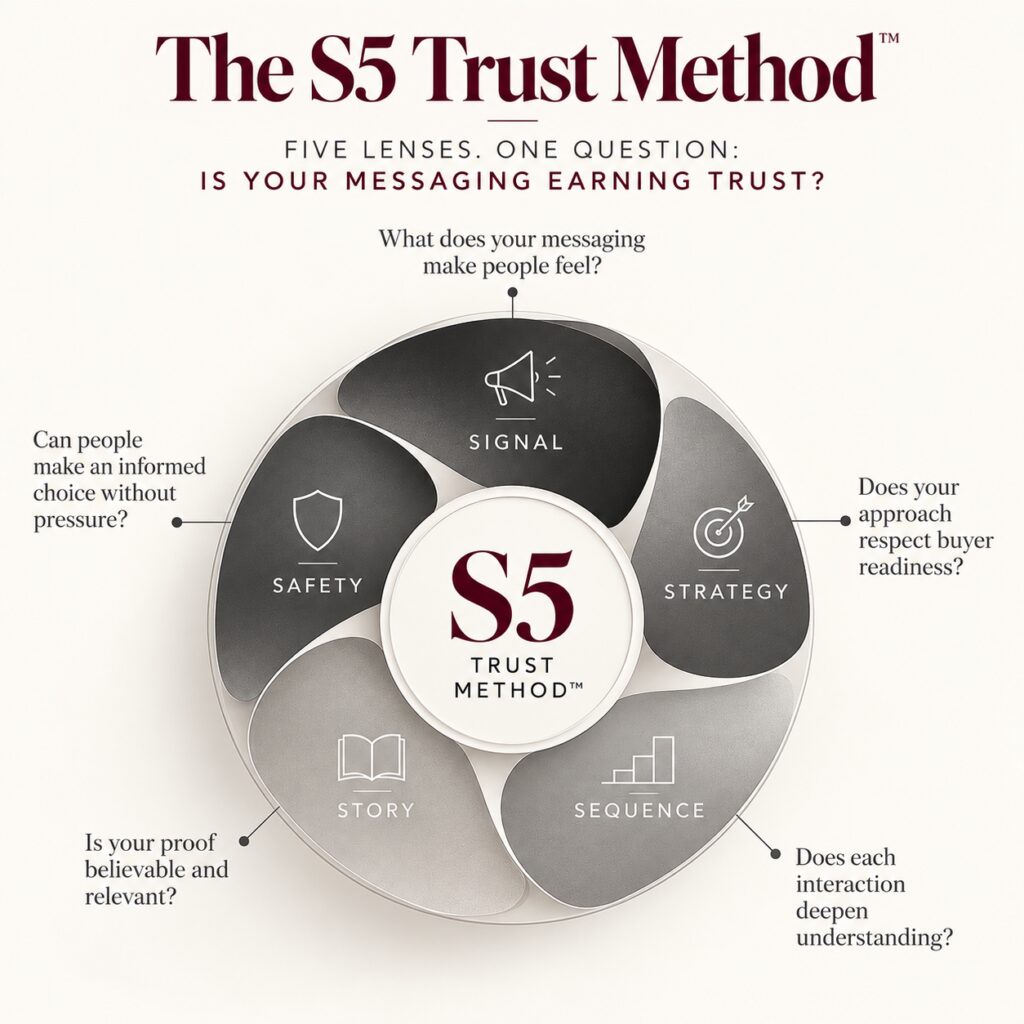
Signal: What does your messaging make people feel?
Every business, every message carries a tone and emotional resonance.
An ad can be informative and confident, or it can make someone anxious about a problem they hadn’t been particularly worried about.
Signal examines whether the emotional experience created by your messaging aligns with your brand and the people you want to serve.
For a wellness brand, that might mean questioning whether fear-based creative is attracting attention at the expense of credibility.
Or if an ad is appealing to the wrong audience and running up adspend.
An ad can earn a click and still leave the wrong impression.
Strategy: Are you respecting the customer’s readiness?
A person learning about a product category isn’t necessarily ready for a sales pitch.
Strategy examines whether your marketing gives people room to understand their options and make decisions at a pace that makes sense.
Are you assuming everyone who clicks an ad is ready to buy? Or do they need more education on the product?
Is there a useful path for customers who still have questions, like a Q&A page?
For wellness products, especially those involving unfamiliar ingredients or devices, education may be necessary before a purchase feels reasonable.
Sequence: Does each interaction build on the last?
Imagine clicking an ad about a specific benefit and landing on a page that mentions it way down at the bottom of the page.
The customer might not stay on the page long enough to discover the answer they’re looking for.
Sequence examines whether your ads, pages, and emails build deeper understanding or leave gaps.
Every interaction needs to help the customer understand the transformation that’s being offered, not just shove them into a time-urgent checkout sequence.
Story: Is your proof believable?
Remember those supplement reviews? They looked reassuring if I’d have stopped at the star rating and didn’t keep reading.
Reading them changed everything.
Story examines whether your messaging reflects genuine experiences and helps customers recognize themselves in what you’re communicating.
That includes how you use testimonials and case studies.
Do you have recent case studies with enough context to be credible?
Can customers understand what actually happened rather than being handed a glowing conclusion?
Stories with substance (like the founder’s story) can do a lot of heavy lifting across emails, content, ads, etc. and do a lot to build trust.
Safety: Can customers make an informed decision without excessive pressure?
Safety examines the transparency, agency, and reassurance that’s coming through in your messaging.
For a supplement, that might mean clear ingredient information, realistic claims, and accessible answers to common questions.
For a red light therapy device, it might mean understandable specifications, appropriate usage information, and straightforward purchase terms.
Guarantees can go a long way in creating safety. As do genuine time-limited promotions that don’t just reset the timer.
The S5 framework is a start
S5 isn’t something I quickly run as an AI agent and have it magically decode a trust factor and spit out recommendations.
It’s done by a human (me!) because you are marketing to humans.
I go through your funnel and marketing assets with cold eyes like a potential customer does in the wild. Because it’s true that sometimes you can be too close to your own meatloaf to appreciate how much seasoning is missing.
S5 gives me a consistent framework where I can identify potential messaging gaps and develop hypotheses worth investigating and/or fixing.
Maybe the problem is that the emotional tone of an ad is jarring compared to the language they use when talking about it.
Maybe the problem is that they signed up on their phone and didn’t open your email right away so they didn’t recognize you and marked you as spam.
Maybe your product page loads too slowly and impatience wins the scroll.
Maybe 5-star reviews aren’t as reassuring as you think.
Instead of random edits, investigate for specific potential trust gaps and develop meaningful tests.
But there’s one essential ingredient to trust that I need to mention, and it’s something many businesses neglect to do.
You need to hear from customers themselves.

When did you last talk one-to-one with your customers?
I’m not talking about just sending a survey with five multiple-choice questions.
Actually have a human to human chat.
When did you last ask someone why they considered your product? What else they looked at? What nearly stopped them from purchasing?
What finally helped them decide?
And if they didn’t buy, why? What was missing?
Those conversations can reveal things that won’t show up in your dashboard.
You might discover that an ingredient you keep highlighting isn’t particularly important to buyers.
Or that your customers are more concerned about sourcing than the benefit your ads emphasize.
Maybe they find your testimonials vague.
Or perhaps the information they need is already on your website, but buried where nobody thinks to look.
These aren’t findings you should invent in a conference room. You need to ask.
I’m particularly interested when a brand is still relying on audience research conducted two or more years ago.
That research may contain useful insights. But have customer priorities changed? Have new competitors entered the category? Are buyers asking different questions?
You may be building today’s creative around yesterday’s customer.
This is the kind of investigation behind my Conversion Intel Report.
Depending on the scope, it can include one-to-one conversations with a brand’s buyers, alongside research into customer language, competing offers, messaging, and creative opportunities.
The purpose isn’t to collect information for the sake of handing over a hefty report that collects dust.
It’s to find out which assumptions deserve challenging and which ideas have enough substance behind them to test.
Sometimes you need better intelligence behind the creative you’ve already got.
Is your marketing deliberately earning trust or simply taking it for granted?
Before you spend more money on the next campaign, consider three questions.
- Do you know what makes prospective customers skeptical about your product or brand?
- When did you last gather firsthand evidence about what influences their buying decisions?
- Are your ads, product pages, emails, and testimonials answering those concerns, or simply bludgering people to buy?
If you’re not sure, that’s useful information in itself.
The S5 Trust Method™ provides a framework for examining how your messaging might earn or undermine confidence.
And current customer research gives you something more reliable than assumptions to build your next creative strategy around.
Because assumptions are an expensive thing to put your marketing dollars behind.
Before your next campaign, get inside the head of your customers.
My Conversion Intel Report helps health and wellness brands investigate their customers, their competitors, uncover messaging gaps, and identify stronger ideas to test before committing more money to ad creative or a new marketing strategy.
If you suspect there’s a gap between what your marketing says and what your customers actually need to hear, I’d be interested in exploring it with you.
Book a discovery call to discuss where deeper customer research could lead to more conversions.
